

THE TEMPORARY MAN
Some things decay from the outside in. A man can too, unless he comes home.
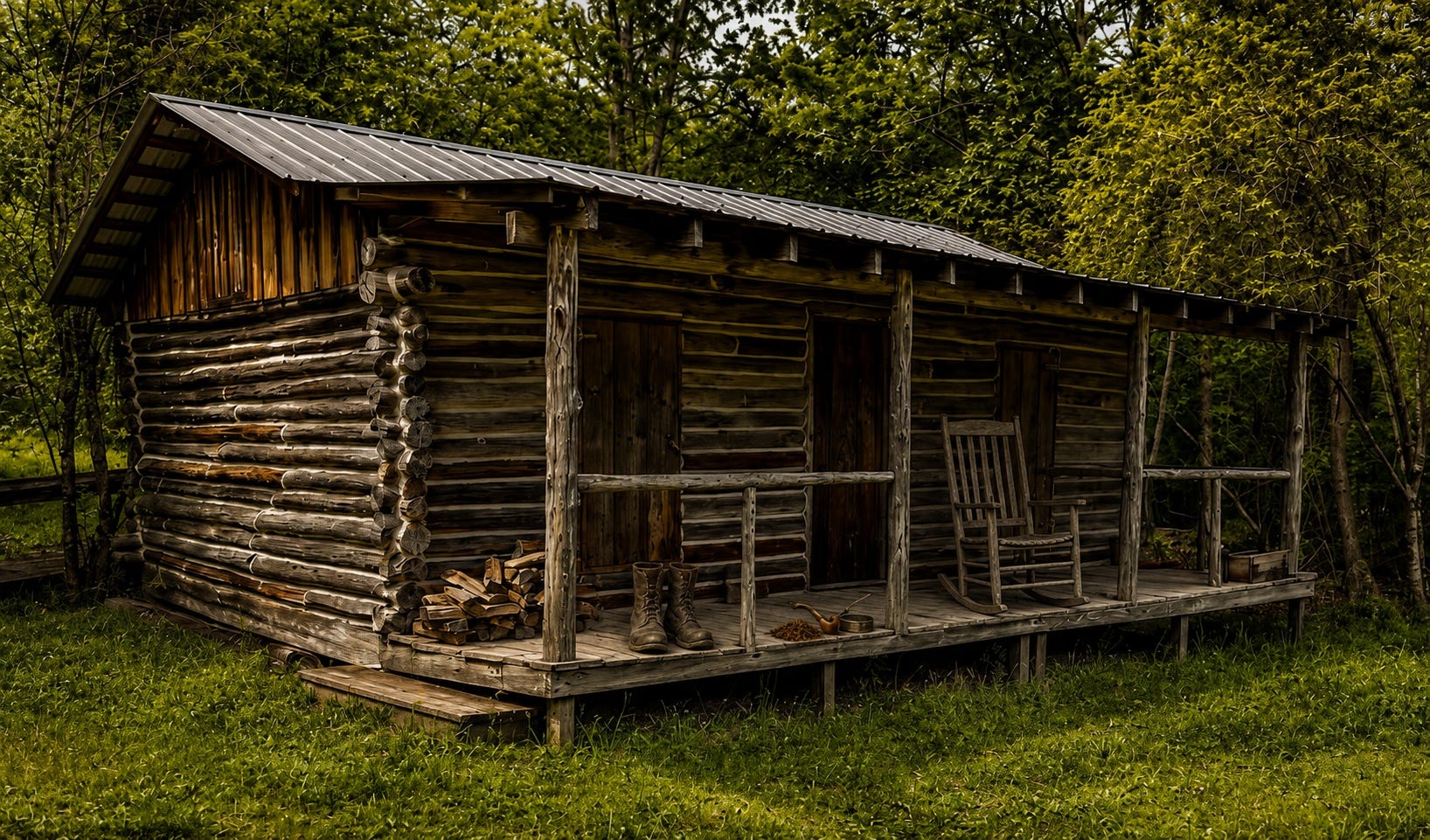
April 26, 2025 — around one o’clock in the afternoon. Marty sent me this photo from Arkansas, where she was at a women’s retreat. She was on a break with a friend, and somehow they ended up on a quick tour through a historical area — a guide walking them past this old cabin while telling the story of the Civil War. She snapped the picture and sent it to me because she knows how much I love old, weathered places. For one brief moment, I wondered if she had gone house shopping without me and found the ideal log cabin she wanted us to live in. Thank God that was not the case. But the longer I looked, the more I felt the invitation. Not just to see it. To sit there awhile.
An old cabin in the Arkansas trees.
Everyone who first called it home is gone.
It is still standing.
And it asked me a question I have not been able to put down.
DEDICATION
To the Holy Spirit, who reminds me that every opportunity is a moment to pause — to reflect on who we are, what is coming, and where we are going.
To Marty, who is always thinking of me — inspired enough by an old cabin in Arkansas to stop, take the photograph, and send it my way. This Spark exists because she saw it first.
To Sam Ramsdale, who lived simply in the mountains above Boulder Creek — and without ever knowing it, handed a boy something that outlasted him.
To the reader — may you be inspired, may you identify what matters most, and may you find the places where your temporary life is asking for more than a temporary look.
SCRIPTURE
“So teach us to number our days, that we may gain a heart of wisdom.” — Psalm 90:12 (NKJV)
“I am the vine, you are the branches. He who abides in Me, and I in him, bears much fruit; for without Me you can do nothing.” — John 15:5 (NKJV)
“For what profit is it to a man if he gains the whole world, and loses his own soul?” — Matthew 16:26 (NKJV)
THE HOOK
The cabin Marty sent me did more than make me think about history.
It took me back.
Not to Arkansas.
To Boulder Creek.
To the mountains above Boulder Creek, into the woods, not far from the cabin my parents owned — the one where I stayed with my grandfather during the summers when I was a boy.
Those were hard years for me.
Harder than I knew how to explain at the time.
I was under the control and toxic influence of my grandfather, and there are some things a child does not yet have words for. He was not just a hard man. Something in him had gone beyond the surface. The mold had gone all the way to the bone, and no pocketknife could cut it away.
So I learned to look for air.
The woods became that for me.
A place to breathe.
A place to wander.
A place where the pressure lifted for a little while.
And one of the places I loved most was the cabin where Sam Ramsdale lived.
THE STORY
Sam lived in the mountains above Boulder Creek, tucked back into the woods.
I met him as a child through my parents. He was their friend, but to me, he stood apart from almost every adult I knew.
He was not a believer, at least not in the way I understand belief now. He believed there was some kind of higher authority, but I do not remember him speaking the name of God.
He was not really a mentor, either.
Not in a formal way.
He was more like a mountain man philosopher — a free spirit, a hippie throwback, a simple man whose life stood apart from everyone else I knew.
When he was not working, I remember him wearing a hippie-style American flag headband around his forehead. It fit him. Back then, in the 1970s, some highly intelligent people did not dress to impress anyone. Sam was like that.
Most of the time, I remember him in the same rusty old clothes. I do not really remember seeing him out of them. Work clothes, mountain clothes, thinking clothes — with Sam, it all seemed to be the same thing.
But his mind never stopped.
As soon as you walked into a room with him, you could almost see his eyes turning.
Processing.
Measuring.
Solving.
Taking everything in.
He had a little stutter, a stammer, and a nervous energy about him — not because he was scattered, but because his mind was always working ahead of the room.
Anything that became a thought-provoking challenge, Sam was all over it.
He was one of the simplest highly intelligent people I knew as a child.
I was exposed to him often because I spent summers in those mountains.
And I remember how excited I would get on the weekends, because I knew I could go see Sam.
He had ways that were so different from other people.
He worked for a large aerospace company. He was an engineer. He could have lived with far more comfort than he did. He could have owned more, displayed more, collected more, and managed more.
But he lived in a little cabin shack with an outhouse outside, no running water, and no bathroom inside.
He brought water in jugs, or drew it from the creek. Every night after work, he would drive about forty miles back into the mountains, park his old white Dodge van up on the flat, and make his way into the cabin.
That van was part of him.
Tools in the back.
Parts scattered around.
Evidence of whatever he was fixing, patching, adding, repairing, or keeping alive.
He was always working on something.
A little add-on.
A small repair.
A piece of the cabin that needed attention.
He did not own much. Maybe two or three shirts. A couple pairs of pants. A couple pairs of boots. Clothes worn down by use, not display.
The kind of life most people would look at and think he could have had more.
But I think Sam understood something most people miss.
The more you have, the more you have to manage.
The more you collect, the more you have to monitor its decay.
Tools rust.
Vans break.
Leather cracks.
Wood rots.
Roofs sag.
Food spoils.
Bodies age.
Everything here keeps telling the truth, whether we want to hear it or not.
Sam rolled his own cigarettes and smoked a corn cob pipe. I can still remember him holding that pipe in his mouth, the smell of the tobacco hanging in the air around that cabin. It is funny what stays with a boy — not just the words, but the smells, the sounds, and the way a man carried himself without trying to explain who he was.
Sam liked his coffee black.
I did not.
I was young, maybe ten years old, but I had already been introduced to coffee. I liked to sip it, but I wanted cream in mine.
Sam would tell me not to put cream in it because cream did not keep.
Black coffee, he said, keeps.
Just drink it as it is.
Because the more we add, the more complicated things get.
That was Sam.
Simple coffee.
Simple clothes.
Simple cabin.
Simple tools.
Simple words that stayed with me long after I left those woods.
I did not yet know how much I would need them.
Years later, I would understand Sam in a way I could not have understood as a boy.
I was about twenty-four years old and had just stepped into taking over Du-All. We needed a grainer — a large sanding machine used to grain aluminum. It was one of the first major pieces I wanted to add to the company so we could grow.
I started looking for one.
They were expensive.
Tens of thousands of dollars.
Sam looked at it differently.
He was an engineer, and he said, “I can build that.”
Not in a proud way.
Not in a flashy way.
Just matter-of-fact, like a man looking at a problem and seeing the parts inside it.
So he went to Orchard Supply Hardware.
He bought screws, bolts, nuts, bearings, framework, and whatever else he needed. He welded it together over a couple of weekends and built one of the most impressive custom grainers I had ever seen.
It was adjustable.
Practical.
Strong.
Built from ordinary parts by a man who understood how things worked.
Then he looked at it and said, “Do you want a smaller one too?”
So he built that one too.
That was Sam.
He could see the larger problem, then see the smaller need inside it.
And those machines helped change the economics of the business.
For decades, that grainer made money.
It never failed.
I never had to rebuild it.
I changed belts, cleaned it, oiled it, greased it, and kept using it.
When I eventually closed and sold the business, I do not know what happened to that grainer. But I remember the new owner looking at it and saying, “Wow. That is an impressive custom grainer. I have never seen one like that.”
Built from parts from Orchard Supply Hardware.
That was Sam.
But not long after he built those grainers, I got the phone call.
Sam was gone.
That hit me hard.
His temporary had finally come to pass.
And there were those machines — still standing, still working, still producing — built by a man who was no longer here to see what they would become.
A man passes through.
But what he builds, what he teaches, what he repairs, what he leaves in another person — some of that keeps working long after he is gone.
THE MOMENT
When I remember Sam, I do not go first to the grainer.
I go back to the fire pit.
I remember sitting outside with him near the fire, talking in that mountain air.
He loved cheese.
And he often had blocks of it around that looked ruined to me.
The outside would be covered in mold, and I would look at it like there was no way we could eat that.
But Sam would take out his pocketknife.
He would cut away the outside and tell me the outside was temporary. It was there to protect the inside from harm.
Cheese, he said, decays from the outside in. So you cut down to the place where the decay is gone, and underneath there is still something good.
Then he would hand me a clean, fresh, pearly white piece.
And I would taste it and think, Wow. This is good.
I did not know it then, but a lesson was being planted in me.
Some things only need the temporary part cut away.
Some things are still good beneath what the world sees first.
And maybe that is why I remember Sam so clearly.
Because in a hard season, under a hard authority, I found my way through the woods to a man with rusty clothes, a restless mind, a black cup of coffee, an old white van full of tools, and a way of teaching me that the outside was not always the whole story.
Sometimes temporary words leave permanent marks.
Some things spoken to us in passing do not pass. A sentence may be temporary in the mouth of the one who says it, but permanent in the heart of the child who receives it.
Sam’s words did that in one way.
My grandfather’s influence did it in another.
One gave breath.
One brought weight.
And both left me holding the same question: what is passing through us — and what is remaining in us?
Not everything marked by time is ruined.
Not everything with decay on the outside is dead on the inside.
THE TURN
That old cabin in Arkansas did not just make me think about an old building.
It made me remember a boy in the woods.
A hard season.
A mountain cabin.
A white Dodge van.
A pocketknife.
A block of cheese.
A cup of black coffee.
A handmade grainer.
A corn cob pipe.
And a man who kept showing me that everything on the outside was passing away.
Then it made me wonder how many stories had passed through that Arkansas doorway.
How many hands touched those walls.
How many boots crossed that porch.
How many meals were eaten there.
How many arguments were left unfinished.
How many prayers were whispered in rooms no one remembers.
Walls like that have heard more than they will ever say.
It stood through years most people only read about now. Through weather, change, loss, silence, and the passing of generations.
The hands that built it are gone.
The voices that filled it are gone.
The footsteps that crossed that porch are gone.
But the cabin remained.
That is what caught me.
Because cabins do not remain by accident.
Wood rots.
Roofs sag.
Foundations shift.
Old places disappear into the ground all the time. Many buildings from that same era are gone now — sunk, burned, forgotten, reclaimed by the earth.
But this one stood.
Somebody maintained it.
Somebody remembered it.
Somebody believed the story was worth preserving.
And the more I looked at it, the more I thought about people.
Because our lives are temporary too.
We like to pretend they are not.
We build.
We plan.
We collect.
We schedule.
We assume there will be more time to say the thing, forgive the person, obey the call, surrender the hidden room.
When a hard season comes, we comfort ourselves the same way every time.
It is only temporary.
We forget the good seasons are only temporary too.
And here is the strange part.
We stand there sorting our lives into temporary and permanent — and we are doing the sorting from a body that is temporary at all times.
The one doing the measuring is as passing as the thing being measured.
All of life is temporary.
That is not the discouraging part.
That is the extraordinary part.
Because if all of it is passing, then none of it is throwaway.
Every day carries weight.
Every season is asking to be lived, not waited out.
The cabin may still be standing — but everyone who first called it home is gone.
That does something to a man when he lets himself sit with it.
It made me think about a question deeper than where a man sleeps.
Where is your home?
Not your address.
Not the town you came from.
Not the place your mail gets delivered.
Where is your soul living?
A man can live in one house while his soul is renting space somewhere else. He can sleep under one roof and still be scattered across old wounds, old regrets, old ambitions, old fears, and old names God never asked him to keep carrying.
Sometimes the soul does not need a new address.
It needs to come home.
There is a difference between being in a temporary season and living a temporary life.
A temporary season can be something God uses.
A wilderness.
A waiting room.
A healing place.
A forming place.
Seasons when the ground under us feels unfinished do not make us faithless. They may simply mean we are being formed.
But a temporary life is different.
A temporary life is an avoidance system.
It is what happens when a man gets so used to holding back that he starts calling it wisdom.
He stays close enough to responsibility to appear interested, but far enough away to avoid the cost.
Close enough to surrender to talk about it.
Far enough away to stay in control.
He does not fully leave.
He does not fully enter.
He hovers.
He rents space beside the call.
He can look responsible from a distance.
He can sound thoughtful.
He can have gifts, dreams, and language.
He can talk about what he is going to do one day.
But someday can become a hiding place.
Potential can become a shelter.
And a man can spend years protecting the idea of who he might become while never surrendering to the work required to become him.
I know this man because parts of him lived in me.
There were places in my life where I held back just enough to stay in what I thought was control. I could give a lot. I could work hard. I could show up. I could care deeply.
But there were still rooms I kept reserved for myself.
An exit.
A fallback.
A corner I did not fully surrender.
I learned something the hard way.
Ninety-nine percent of something is one hundred percent of nothing.
Almost surrendered is not surrendered.
A lot of men were taught that surrender is weakness.
Wars taught us not to surrender to the enemy.
Pain taught us not to surrender to people.
Wounds taught us not to surrender control.
I have seen it in rooms full of men. At retreats — a hundred and fifty, two hundred men — a leader would ask, “How many of you had a great relationship with your dad?”
Only a few hands would go up.
That tells a story.
A boy learns early whether it is safe to trust.
Whether authority is something that protects him or something that wounds him.
And if a man has never known healthy authority, surrender can feel like defeat.
But surrender is only weakness when we surrender to the wrong authority.
Surrender to fear will shrink a man.
Surrender to pride will harden him.
Surrender to comfort will numb him.
Surrender to Jesus will make him whole.
And Jesus does not meet the temporary man with a hammer in His hand, ready to crush him for every year he delayed.
He meets him like shelter.
Like sunlight.
Like food for the soul.
Like a strong chair under a tired body.
Like a rocking chair on an old porch, inviting the man who has been pacing his whole life to finally sit down long enough to tell the truth.
That is mercy.
Not permission to remain temporary.
Strength to come home.
THE DRIFT
The temporary man has a voice that keeps him company.
It sounds like this:
Keep your options open.
Never give anyone all of you. That is how men get hurt.
You will settle in once things calm down.
Staying loose is not avoidance. It is wisdom.
It sounds careful. Measured. Almost mature.
I called it wisdom too.
For years it was a packed bag sitting by the door of a life I was invited to own.
But that cabin did not remain because somebody kept their options open.
It remained because somebody stayed.
THE REFLECTION
A man can spend years around the things of God and never move into the life God is calling him to live.
He can go to church.
Read the Bible.
Pray the prayers.
Serve in the room.
Know the language.
And still follow from a distance.
Because proximity is not the same as connection.
A branch lying near the vine is still disconnected.
Jesus did not say to stand near Him and bear fruit.
He said to abide.
Remain.
Stay.
Live connected.
The temporary man keeps asking God for fruit while refusing the rooted life that produces it.
He wants peace without surrender.
Purpose without obedience.
Legacy without discipline.
Fruit without abiding.
But the branch does not bear fruit because it tries harder.
It bears fruit because it remains.
That old cabin remained because it was tended.
Its story was not preserved by accident.
Neither is a life.
A life that carries weight must be tended.
A character that remains must be guarded.
A testimony that outlives us must be lived intentionally.
Time is honest about this.
Psalm 90 says to number our days — not so we gain a heart of panic, or a heart of regret, but a heart of wisdom. And wisdom stops pretending there will always be more time.
Wisdom looks at the old porch, the weathered walls, the story that somehow remained, and asks the harder question:
What am I doing with the life God placed in my hands?
I looked at that cabin and saw something weathered.
I know what that feels like.
Weathered by years.
Weathered by battles.
Weathered by loss.
Weathered by things remembered and things forgotten.
But weathered does not mean wasted.
Weathered wood can still stand.
A weathered man can still carry wisdom.
A weathered life can still become testimony.
And the older I get, the more temporary life becomes impossible to ignore.
When I was younger, I would buy things and wonder how long they would last.
A car.
A house.
A tool.
A camera.
A pocketknife.
Would it hold up?
Would it be worth the money?
Would it last long enough to matter?
Now I find myself asking a different question.
Will it outlast me?
That question changes a man.
A pocketknife can outlive the hand that carried it. A tool can remain in a drawer long after the man who used it is gone. A photograph can outlast the eye that framed it. A house can still be standing after every person who first called it home has returned to the ground.
Even the things we call disposable can remain longer than we do.
That is sobering.
Because the body does not stay.
The flesh gives way.
The body returns to the soil.
What we dressed, fed, protected, strengthened, treated, and worried over eventually releases its claim.
And still, something remains.
Scripture speaks of bones more than once — dry bones, buried bones, bones that testify that God is able to speak life where everyone else sees only what is left behind.
I do not want to press that farther than it should go, but I do think bones remind us of something.
A life was here.
A person walked here.
Someone loved, worked, failed, endured, prayed, carried wounds, made choices, and passed through.
The body is temporary, but the life was not meaningless.
That is where Jesus changes the whole story for me.
Because without Him, temporary can feel cruel. It can feel like everything we build, love, hold, and become is slowly being taken from us.
But in Christ, temporary is not the same as empty.
Temporary is not the same as wasted.
Temporary is not the same as lost.
When I think about Marty, I do not think of our love as something that simply expires when the body gives way. I believe what Christ has formed in love is not lost when flesh returns to dust.
Our marriage has been lived here, in time, inside temporary bodies, through temporary seasons, in a temporary world.
But Jesus has been at the center of it.
And what He holds is not fragile.
That gives me peace.
I have seen people near the end who did not know where they were going. I have watched the weight that comes into a room when a person has no anchor beyond the body.
I do not say that with judgment.
I say it with heaviness.
Because the question eventually comes for all of us.
Where are you going?
Not where are your things going.
Not who gets the tools, the house, the photographs, the pocketknife, the old van, the furniture, the files, the memories.
Where are you going?
That is the question the temporary man cannot afford to avoid.
And by the mercy of Jesus, I have peace with my answer.
I know where I am going.
This world is temporary, but I am not headed toward nothing.
I am passing through a temporary place on my way to a permanent one.
There was a time when I was an overachiever.
I pushed, proved, built, and carried.
But life has a way of humbling a man, and God has a way of teaching him the difference between achievement and overcoming.
I do not want my life remembered because I achieved everything.
I want it to testify that I overcame.
Not by my own strength.
Not because I never failed.
But because Jesus kept calling me out of temporary places and into rooted ones.
From control into surrender.
From performance into abiding.
From holding back into becoming intentional.
A temporary man can become an intentional man.
But not by accident.
He becomes intentional when he stops waiting for someday to do what obedience is asking of him today.
When he stops blaming his wounds and starts bringing them under the authority of Christ.
When he quits standing near the doorway — and finally steps inside.
We are temporary men, but we are not called to live temporary lives.
WALKAWAY LINE
We are temporary men passing through a temporary world, but in Christ, we are not called to live temporary lives.
SOMETHING TO THINK ABOUT
Where are you still renting space beside the call — and what has staying there cost you?
Where is your home, and where is your soul living? Are they in the same house?
What would change if you stopped waiting for someday and stepped inside today?
MY PRAYER
Heavenly Father,
Teach me to number my days — not in fear, but in wisdom.
Show me where I have lived temporary.
Show me the corners I have held back, the rooms I kept reserved, the call I stood beside but never fully entered.
Cut away what has been decaying from the outside in.
Do not let me mistake damage for death, delay for safety, or proximity for surrender.
Teach me to abide in You.
To remain when I want to run.
To surrender to Your authority — not as defeat, but as life.
Make me intentional.
Make me rooted.
Make me faithful.
Let my life carry more than activity.
Let it carry fruit.
Let it become testimony.
And when this temporary body gives way, let what You formed in me remain in You.
I do not want to live beside the life You called me to.
I want to come home.
In Jesus’ name, Amen.
ABOUT G~
G~ writes from lived experience — exploring identity, authority, and time through the lens of faith, trial, leadership, and surrender. His reflections are not meant to condemn or hype, but to steady. Rooted in covenant, forged through adversity, and anchored under the authority of Jesus Christ, his work invites readers to examine who governs their lives — and to live intentionally under truth.
If what you’ve read resonates with your journey, feel free to reach out.
G~