

THE SWITCHBACK
Where mercy bends the road before momentum breaks us
June 15, 2026.
I was sitting at my sister’s place in the woods, a quiet place for me — the kind of place where my thoughts slow down enough to hear what is rising underneath them.
I had sat down to write a Spark.
Then a text came through from my friend Bob.
Bob is a dear friend — to my sister, to Marty, and to me. We met him years ago, up near my sister’s place. He comes to camp, hikes the dogs, and travels the states with a camera in hand, always hunting a piece of God’s creation worth getting in front of. He sees country with the kind of eye that makes you stop and look twice.
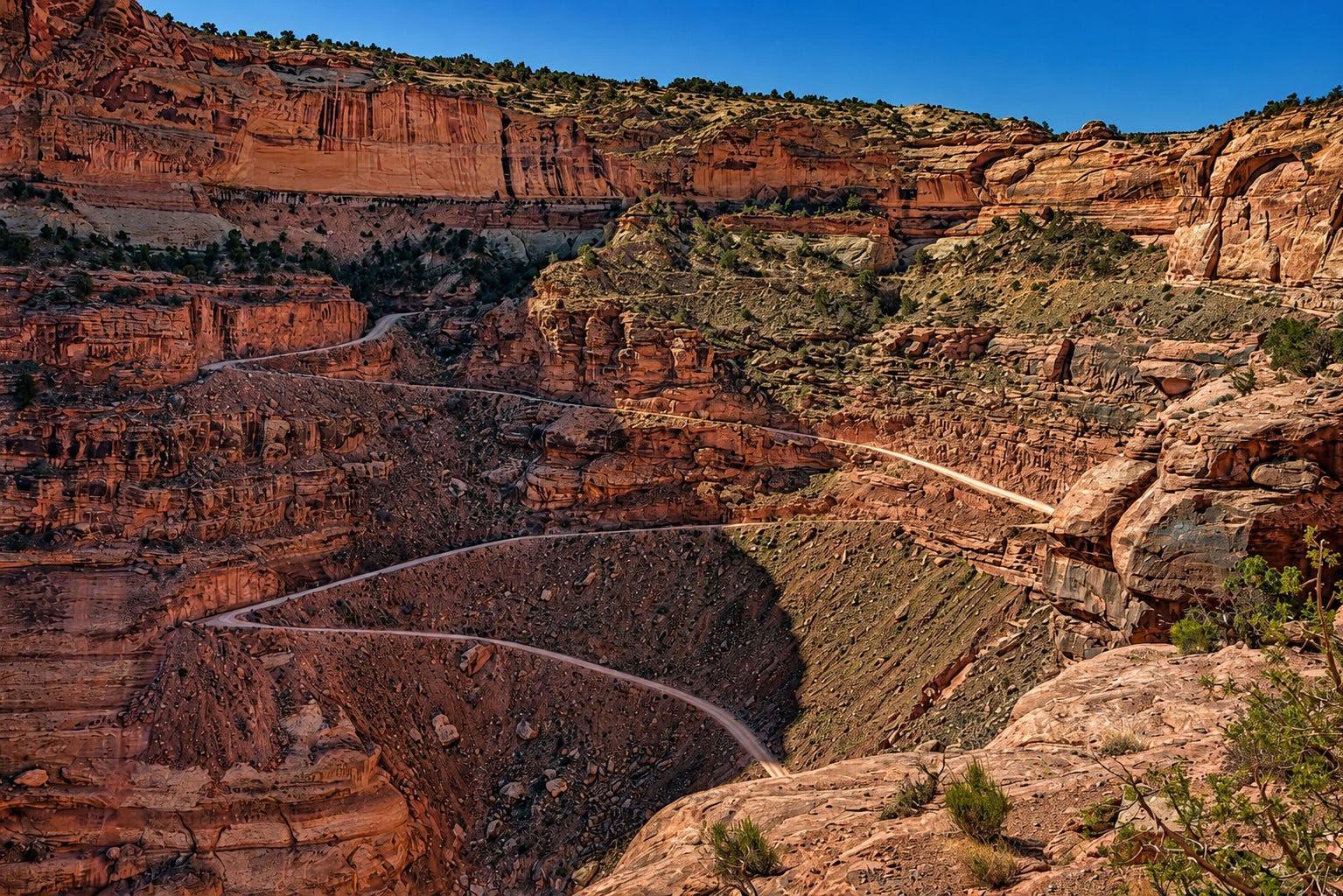
He sent me this — Shafer Canyon Road in Utah. A switchback carved through red rock, turning back on itself again and again as it works its way down toward the bends of the Colorado River below.
The moment I saw it, my jaw dropped.
I said, “That’s my next Spark.”
I asked Bob if I could use his photo. He said yes.
So before this goes any further — thank you, Bob.
This photograph did more than capture a trail.
It opened one.
You can feel it at the top of any hill.
The pull to go.
The quiet certainty that you can handle whatever is waiting at the bottom.
DEDICATION
To the Holy Spirit — who knows how to use a photograph, a memory, and a quiet place in the woods to bring an old lesson back with new mercy.
To my wife, Marty — who has blazed and traveled every trail with me, the guardrail on the narrow stretches and the second set of eyes I never knew I needed. She is a treasure beyond measure, God’s gift to me, the love of my life.
To my friend Bob — for the photograph that stopped me in my tracks.
To Ronnie — who taught me more than he probably knew. A bush pilot, a hunter, a guide, a grit-filled soul whose life was wrapped around those Idaho ranges and the elk that moved through them. When he said yes, he meant yes. When he said no, he meant no.
To the men I once hunted with in the high country, and to the country itself — the horses, the mules, the snow, the cold air, the wild places. Most of those men are gone now, but their voices, their grit, their laughter, and their lessons still ride somewhere in the backcountry of my memory.
And to the reader standing at the top of a hill, feeling the pull of momentum, wondering whether to head down.
Pause first.
Ask God before the descent.
Some roads are not meant to be taken by confidence alone.
SCRIPTURE
“Trust in the LORD with all your heart, And lean not on your own understanding; In all your ways acknowledge Him, And He shall direct your paths.” — Proverbs 3:5–6 (NKJV)
THE HOOK
A switchback is not the fastest way down a mountain.
That is the mercy of it.
A switchback makes you turn before the drop takes you. It slows your confidence. It forces you to respect the grade. It reminds you that straight lines are not always wisdom, especially when the road is narrow, the ground is loose, and one wrong decision can carry consequences all the way to the bottom.
Bob’s photograph was taken in Utah.
But what it opened in me was Idaho.
The Profile Range.
Yellow Pine.
Cougar Mountain Basin.
The high country where friends and I hunted elk, packed mules, cut trail, and learned fast that the mountain does not care how confident a man feels.
We crossed those trails through dry summers and snow-filled winters, when the snow stood six feet deep, sometimes ten. Friends beside me. Mules under load. Tools in hand.
Every mile taught the same lesson.
The mountain only respects humility, preparation, and endurance.
THE STORY
I was in my mid-twenties then — strong, confident, and sure-footed enough to believe I could handle most things the mountain put in front of me.
But I was not arrogant.
By then, life had already handed me enough lessons to know when strength needed to bow to experience. I knew there were moments when a man had to humble himself, listen to those who had gone before him, and let the mountain teach instead of trying to prove something to it.
The men of substance around me gave me a nickname.
KID.
The kid.
The grunt.
The mountain goat.
I earned every bit of it.
I had been brought into the outfit as young help — strong, willing, useful — which meant I got handed just about everything that needed doing.
Feed the horses before daylight.
Saddle the stock.
Load the gear.
Cut the trail.
Help the clients.
Listen more than I talked.
Learn from the men who already knew what one bad decision could cost up there.
Ronnie was one of those men.
He did not learn the mountains from a brochure. He was born into them — a bush pilot, a hunter, a guide, a man of true grit who was part of the soil, part of the dirt, embedded in that rock the way the trail itself was carved into it.
He flew for the Mosquito Abatement Program in Idaho and belonged to the Million Mile Plus Club — millions of miles in a Cessna, reading weather and terrain and risk from the air long before I understood how much wisdom that took.
Men looked to him for the way onto that mountain, and the way back off it alive. He took a lot of people in over the years, me among them, and I can tell you he was one heck of a pilot.
Years later, Ronnie died in a small plane crash going back into that same camp country.
That still settles heavy in me.
If any place ever held Ronnie’s life, it was that country. I cannot explain why that day went wrong. I only know it did, and the weight of it never fully left.
I will come back to that.
It matters more than I knew at the time.
Ronnie taught me a lot.
Not with speeches. Mostly by grit, repetition, and consequence — the kind of mountain wisdom you only learn when one wrong move can end you right where you stand.
You learned to pay attention to everything.
If you saddled your horse wrong and did not allow for heat, sweat, and gut expansion, you were going to learn fast. A bad cinch in that country could put you on the ground, under a load, or draped over the back of a mule before the day was done.
That country gave a man nothing for free.
It was home to high-altitude elk — and once you saw one, you understood what that meant.
These were not ordinary animals wandering through easy country. They were specimens. They lived where most men could not reach them, and that was part of what made them what they were.
To hunt that country, you had to earn your way in.
You might find yourself on the belly side of a horse, hanging on for dear life across a ten-inch trail, looking down a cliff of shale, stone, or snow. You might cross snowdrifts so deep that if you went through wrong, it felt like spring might come before anyone pulled you out.
That was the kind of country that formed a man.
It taught by weight and weather, by fear and failure and repetition.
Every decision in that country felt absolute.
Either you made the right one, or the mountain corrected you.
And somewhere in all of it — under the load, behind the mules, beside men who had already paid their dues — the kid started becoming a man.
We hunted country that did not forgive carelessness.
In summer we flew supplies in low by Cessna — welded fifty-five-gallon drums dropped near the old miner cabins where we would set up camp. When winter came, we brought the clients back in by horse and mule, cutting trail for days through heavy drift snow just to reach it.
The clients were men with money — most of them stepping into that country for the first time. They came with the best of everything: new rifles, new chaps, new thermals, sleeping bags rated for cold they had never felt. Overpacked with gear they were certain would carry them through.
By the end, most of it had not mattered.
What a man actually needed up there could not be bought.
He needed know-how he did not have — and someone he could trust to get him off that mountain alive.
It was treacherous and beautiful at the same time, and the two never traveled apart.
Camp sat around eighty-five hundred feet. The hunting country climbed toward ten thousand. At that elevation, in November, winter does not arrive politely.
It comes with teeth.
You learn quickly that the mountains are not scenery.
They are a test.
And that trip was one a man never fully forgets.
The crash I am about to tell you was not even the worst of it. Before it was over, a client — a doctor — died of altitude sickness before we could get him out, and a horse went down in a way I still do not write about lightly.
Some memories do not leave cleanly.
They stay — not only to haunt you, but to warn you.
This is one of those.
THE MOMENT
It was late.
We were hauling mules into camp — Ronnie at the wheel of a big flatbed diesel, a long trailer behind us.
Snow was falling.
The road was iced over.
At the bottom of the switchback, in a wide turn, the clients had parked their brand-new Suburbans. Five of them. Bought that same year through some business deal. Shiny. Expensive. Lined up right where they never should have been.
The men stood around them with cigars and whiskey, laughing, talking, excited for the trip, waiting for us to come down.
No cell phones.
No way to send word ahead.
No warning.
Ronnie started us down.
Then the trailer began to slide.
Right.
Left.
Correct.
Overcorrect.
Right again.
The headlights caught the snow hanging in the air. The road disappeared under the ice. The weight behind us started making its own decisions.
Ronnie looked over and said, “Hang on, kid.”
And I did.
All I could see were those five Suburbans at the bottom, waiting like targets.
The men saw us coming.
At first they laughed.
They pointed.
They stood there watching it unfold like entertainment.
Then they understood.
We were not just coming down the hill.
We were coming for them.
And instead of moving the vehicles, they scattered.
That mule trailer came down into the turn and tore through every one of them.
Metal folded.
Panels crushed.
Wheels bent.
A few had to be towed out.
The animals were shaken and banged up, desperate to get out of that trailer the moment we could open the door.
Getting them out was the easy part.
We do not lose control at the bottom of the hill.
We lose it at the top — the moment we start down without asking.
THE TURN
I stood there afterward looking at the wreckage — embarrassment, relief, and disbelief all at once.
And I remember Ronnie turning to those men and asking them plainly:
Why didn’t you move your vehicles?
You saw us sliding.
You were laughing and pointing.
Why didn’t you move?
That question stayed with me.
Because the danger had been obvious.
The slide had already started.
Wisdom was standing right in front of them, waving its arms — and still they did not move what was sitting in the path of consequence.
They were watching the big thing.
The trip.
The excitement.
The whiskey and the cigars and the season ahead.
They missed the small thing sliding toward them in the dark.
That is usually how it happens.
Not because the danger is hidden, but because we are looking somewhere else — so fixed on the big thing that we miss the small one already in motion.
Ronnie’s whole life turned on small details done right. And the day it ended, it was a small thing — an ordinary run — that simply went wrong.
And it did not end at the bottom. On the drive home, one of the wrecked Suburbans was still drivable, so they took it — a hunting rifle packed barrel-back on the floorboard, never unloaded, the safety never set, clothes and hangers piled on top. The miles did the rest. The sway and the stop-and-go worked a hanger into the trigger, and somewhere on that road a shot went off and blew the back window clean out. Nobody was behind them. One more small thing, ignored. One more set of choices that became everyone’s consequence.
I have lived parts of my life that way too.
Not with a mule trailer and five Suburbans.
With pride.
With decisions.
With confidence.
With roads I started down before I ever asked God whether I should be on them.
THE DRIFT
The voice at the top of the hill always sounds reasonable.
You have done this before.
You know this road.
Your experience will carry you down.
You can correct it on the way.
And if something goes wrong, you will handle it — you always have.
It sounds like wisdom.
It sounds like confidence earned the hard way.
But experience is not the same as discernment.
And confidence is not the same as surrender.
I know the difference now.
I learned it on an iced-over switchback, hanging on beside a man who knew those mountains better than I knew myself — and even he could only correct so much once the weight behind us started making its own decisions.
THE REFLECTION
For a lot of years, I think I was on a switchback trail and did not know it.
Back and forth.
Turn after turn.
Trial after trial.
Correction after overcorrection.
Trying to manage momentum, I had already handed over to the wrong things.
I thought I was making my own way.
But when I look back now, I can see the mercy.
Jesus was not absent from the trail.
He was bending the road.
He was slowing the descent.
He was keeping me from taking a straight line into destruction.
I did not know it then, but every switchback was part of the way home.
That is what I see now, at sixty-seven.
The mountain I had to climb.
The turns I did not understand.
The men I learned from who are gone now.
The younger version of myself — strong but not yet wise, useful but not yet surrendered — hanging on beside older men while the mountain revealed what kind of man I really was.
And I see Jesus.
Not only at the end of the trail.
On the trail.
In the turns.
In the pauses.
In the near misses.
In the wreckage.
In the mercy that kept bending the road before momentum broke me completely.
He has walked every trail with me — from the day I was born to the day I take my last breath.
Some days still go wrong.
Some things still happen that should not, and do anyway — the way they did for Ronnie.
I cannot control every detail on the descent.
No one can.
But I have learned where to put my trust.
Not in my grip on the wheel.
I ask Jesus to be in the cab before the slide begins.
We carried carabiners on those trails — you clip them to whatever is strong enough to hold you when the ground lets go.
A man clips his life the same way. Too often, to someone else’s choices, until their choices become his consequences.
These days I clip mine to Jesus. I am often put out front to guide, but I am not the one leading — I am under His leadership and the guidance of the Holy Spirit, and He holds the path before me and behind me.
It has been more than half a lifetime since that mountain, and only God could have carried me from that icy switchback to this quiet chair in the woods.
That is why I can receive a memory I would never choose to relive and be glad to give it away — to hand it to someone who has not reached their switchback yet, someone sure they can make the bottom on nerve alone. If it slows even one of them before the slide, nothing on the hard road behind me was wasted.
My faith did not grow strong because the road got easy.
It grew strong because He stayed with me through the hard turns.
WALKAWAY LINE
A switchback is mercy carved into the mountain — a slower way down so we do not destroy ourselves in a straight line.
SOMETHING TO THINK ABOUT
Where in your life are you already starting down the hill, telling yourself you can correct it later?
What big thing has you so fixed that you are missing the small thing already sliding toward you in the dark?
And when you look back at your hardest turns, can you see where mercy was bending the road — slowing a descent you would have taken straight into ruin?
MY PRAYER
Heavenly Father,
Teach me to pause at the top of the hill before I rush into the descent.
Give me eyes to see what pride ignores, humility to ask for Your direction, and the wisdom to know when confidence has quietly become carelessness.
Thank You for the switchbacks You have allowed in my life — the turns, the delays, the corrections, the hard places that slowed me down long enough to find You.
Do not let me mistake momentum for calling.
Do not let me mistake strength for surrender.
And if the turns I have survived can spare someone else a straight line into chaos, let them serve that purpose.
And when the road turns sharp, the ground goes slick, and control begins slipping from my hands, remind me that Your mercy is still greater than my momentum.
In Jesus’ name, Amen.
This story began with a choice that was not mine — Bob’s, to take the picture and send it my way. One man’s choices become another’s consequences. Bob’s became a gift. Thank you, my friend.
ABOUT G~
G~ writes from lived experience — exploring identity, authority, and time through the lens of faith, trial, leadership, and surrender. His reflections are not meant to condemn or hype, but to steady. Rooted in covenant, forged through adversity, and anchored under the authority of Jesus Christ, his work invites readers to examine who governs their lives — and to live intentionally under truth.
If what you’ve read resonates with your journey, feel free to reach out.
G~