
THE FIRST BRICK
The load was never the lesson.
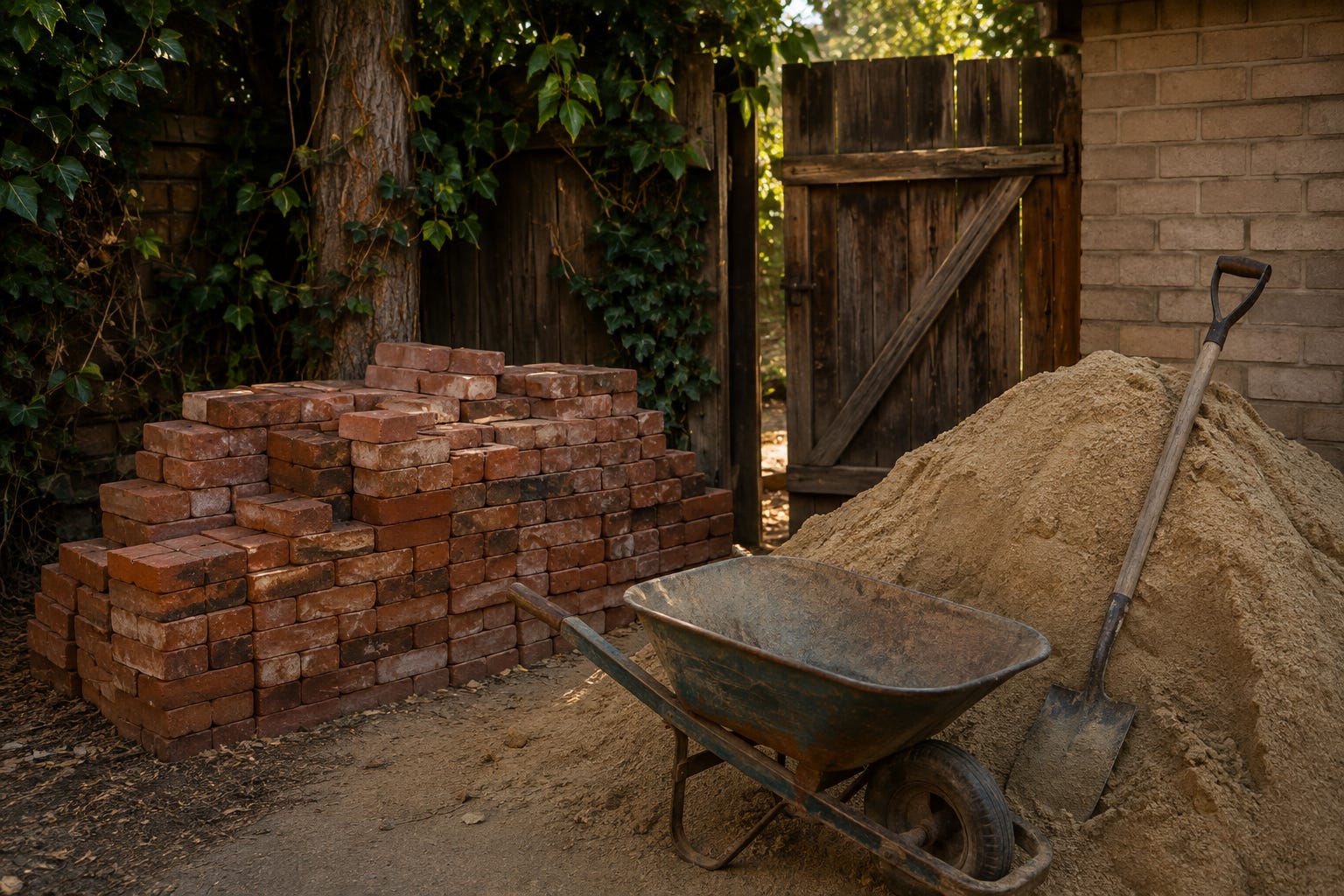
Red clay bricks with white streaks. A pile of sand. A wheelbarrow. I was in seventh grade when these three things started teaching me something it took most of my life to learn.
Before that weekend was over, I had moved five hundred bricks three times.
I thought I was being punished.
It took me decades to see what was actually being built.
DEDICATION
To my childhood — the trials, the adventures, and the friends who were part of it. Even the tough lessons. Especially the tough lessons.
To Neiland, David, and Robin — and every friend across the years who came alongside and helped carry the wheelbarrow. They helped because they wanted to. And they stayed.
To my sister — always willing to pick up the wheelbarrow. Always.
To Marty, my wife — the one who picks up the wheelbarrow, and the one who held the handles when I couldn’t.
To the Holy Spirit — whose hand was on the other handle all along, even when I couldn’t see it. And who guides the wheelbarrow now, leading me where I need to be.
SCRIPTURE
“Bear one another’s burdens, and so fulfill the law of Christ.” — Galatians 6:2 (NKJV)
“Trust in the LORD with all your heart, And lean not on your own understanding; In all your ways acknowledge Him, And He shall direct your paths.” — Proverbs 3:5–6 (NKJV)
THE HOOK
Seventh grade. Friday after school. We got out early, and I was looking forward to some free time.
Instead, I came home to a pile of sand and five hundred red clay bricks streaked with white sitting in the driveway.
I knew I was in for something.
My father came home in a hurry, pointed to a spot in the backyard where it all was supposed to go, and left to go bowling.
The instructions weren’t very clear to me, but I thought I understood them.
What he didn’t say was that the sand had to be spread first, and the bricks laid on top of it. The spot he pointed to was where all of that was supposed to happen.
The plan was in his head. All I got was the pointing.
So I went to work.
I spent the rest of the day moving the sand and every one of those bricks into the backyard with a wheelbarrow.
No gloves.
By the time I finished, my hands were blistered.
But I felt really good about what I had accomplished.
I thought I had done a good job.
Then my father came home.
The sand was where he wanted it.
The bricks were not.
They were sitting on the very ground where the sand needed to be spread.
I tried to explain what I thought I had heard, but he was angry. The explanation was over before it really began.
He told me that the next morning I would move every brick back out to the driveway.
I couldn’t understand why.
I thought maybe he just didn’t like the bricks. Some had broken — they had been hard for me to move.
But Saturday morning, I dug through the garage for an old pair of cloth gloves to cover the blisters, picked up the wheelbarrow, and started moving five hundred bricks back out front.
I wasn’t sure I was going to get through that day.
It wasn’t until every brick was back out front that he told me the rest.
Now I had to move them all back in again — this time to the place he had intended.
That’s when he finally explained.
This was my punishment.
That was the lesson as he saw it:
If you don’t do a job well, you do it again until you do.
Something was being built in that driveway.
It just wasn’t what either of us thought.
THE STORY
Somewhere in the middle of moving those bricks back in on Saturday, Neiland showed up.
Best friend. Baseball waiting. And I wasn’t going anywhere.
He looked at the pile. He looked at me.
“Why?”
I told him the whole story.
Then he said:
“Wait. I’ll be back.”
He crossed the street and gathered the boys.
Before long, five more boys were in the driveway.
Seven boys. One load. Many hands.
The pile didn’t change. Not one brick became lighter. The work was still there.
But it was no longer mine to carry alone.
And somehow, it became fun.
We joked. We goofed off. We played around while we worked.
Every once in a while, one of the boys would climb into the wheelbarrow and I would push him into the backyard.
Seven boys can move five hundred bricks pretty fast when they are laughing.
That job was done lickety-split.
By the time we finished and cleaned up, there was still enough Saturday left for baseball.
When my father saw how quickly I had finished, he could hardly believe it.
By then I wasn’t angry anymore. I was quietly pleased with myself. Seven boys had knocked out in an afternoon what was supposed to cost me a whole weekend, and I had no intention of telling him that.
He never complimented me.
He just asked:
“Did you learn a lesson?”
I nodded.
“Yes, sir.”
I had. Just not only the one he thought he was teaching me.
He never knew the boys had helped.
All these years later, I don’t remember that Saturday primarily for the punishment.
I remember the laughter.
I remember the wheelbarrow.
I remember boys who could have gone and played baseball without me — but didn’t.
They stayed.
Even now, thinking about that driveway can bring a tear to my eye.
Friendship didn’t start in that driveway.
Neiland and I had been finishing each other’s work for years. When he still had chores and I wanted him free, I would go help him get through them. Sometimes I made the case to his mother myself.
“I’ll help him get all his chores done.”
We did that for one another. It was already who we were long before there were ever five hundred bricks.
There were nearly thirty boys in the neighborhood. About a dozen of us were close. Our homes were different, but many of us knew tension. We did not have much language for it. We recognized the weight in one another anyway.
My father tried to close the distance between us the way some fathers do — with gifts. My parents had come up out of the Depression with almost nothing, and once the business started making money, Christmas at our house became abundant. Some years there were ten or fifteen packages. Later, twenty or twenty-five. G.I. Joes, a BB gun, Legos, Lincoln Logs. Hot Wheels was the big one. Everyone wanted the Hot Wheels.
My mother would notice that some of the presents had disappeared. She thought maybe she had hidden them so well she couldn’t find them to put under the tree.
I had quietly let the boys take packages with my name on them and open them under their own trees.
I never did tell her what was happening to those gifts.
I understand now what all those packages were doing. My father wasn’t around much. The gifts were standing in for the thing I actually wanted from him, which was his time.
I didn’t know any of that then. I just gave the presents away.
And what came back was the thing I was actually missing. Time.
Generosity became part of the language of our friendship.
I gave what I had.
When my load became heavy, they gave what they had.
Then I grew up. And the wheelbarrows multiplied.
Marriage. Children. Businesses. Economics. Responsibility. Survival.
The loads got heavier, and I kept doing what I had learned to do.
Carry them myself.
One way. A one-man operation.
Survival stopped being a season. It became a way of life.
But underneath it, I desperately needed help.
I just didn’t know how to ask for it.
I helped everyone. That part came easy — it had roots.
But receiving was different.
Because out in the world, help came with hooks. Leverage. Hidden expectations. Strings you didn’t see until you were already holding the gift.
Some even picked up the wheelbarrow, and I thought their intentions were good.
Far enough down the road, I realized they wanted the contents.
After enough of that, help stopped feeling like relief.
It felt like obligation.
I didn’t want to owe anybody anything. I didn’t want to wonder what would be expected later.
So I learned not to ask.
Not to take.
Not to receive.
The wheelbarrow got bigger.
And deeper.
But there were a few.
They came in different seasons of my life.
Neiland. David. Robin. My sister. Marty. A handful of others across the years.
You could feel their genuineness before they ever had to prove it.
No leverage. No scorekeeping. No hidden obligation.
I didn’t have to prove anything to them.
They stayed. They met me where I stood.
David told me that one of the things he loves about me is my gratitude.
That made me smile, because it is one of the things I love about him too.
Maybe that is part of what I recognize in people like him. They are grateful for what is here instead of always reaching for what isn’t.
There’s something whole about people like that.
Some people help you lift a brick.
Some help you carry the load.
And a rare few pick up the wheelbarrow.
David was one of the rare few. We met in a Bakersfield wine store in 2010. He kept inviting me into a men’s ministry until I finally said yes. He never forced the door. He kept it open.
Across the years, we traveled, prayed, ate, and ministered together. He was the guy who would show up for my surgeries and wait right alongside my wife. He carried spiritual, emotional, and physical burdens without asking for anything in return.
And then there is my sister.
Everyone else came into my life in seasons. She was there the day I was born.
She remembers days I don’t — because she was there for all of them.
She picked up the wheelbarrow on day one. She has never set it down.
There are certain people you trust with your life.
My sister and my wife are those two.
The stories would take too long to tell. She knows them. So do I.
Years later, my father passed away. A few years after that, his wife followed him.
With that phone call came an enormous task. He had lived two thousand miles away, in Arkansas, on a hundred and fifty acres, and his home held years of collections and years of neglect. Someone had to take it apart, piece by piece, and prepare it for sale.
Marty got to the property ahead of me. I landed late and drove two hours from the airport back into the Ozark Mountains.
It was dark when she pulled up. She stayed out in the vehicle, and the people inside never knew she was there. Through the lit windows she watched them put things into their purses, carry things out the door, and load their cars.
Friends of my parents, helping themselves to what belonged to the dead.
She called me while I was still driving in.
“You’re not going to believe this. People are stealing stuff, and I don’t know what to do.”
“Don’t do anything. Just stay there silently. I’ll be there.”
When I walked in, I said hello.
The stealing stopped. Everyone behaved as though nothing had happened.
As they were leaving, I told them:
“Hey, just so you guys know — if there’s anything you want, I’d be happy to give it to you. Just let me know what it is first.”
I meant it. Before that trip was over I had given away a couple of tractors and most of the yard equipment. The things were never what mattered.
Later, after I handed over property to one of the people who had been in that house that night, I finally said what was actually sitting between us.
“So now you realize you and your wife didn’t have to come over that night and steal?”
It was never about what they took.
It was that they decided stealing was safer than asking.
And standing there in the dark, I realized something.
My trust had been broken as a child. And here it was, broken again.
I called friends. I called family. I told them they could take anything they wanted.
No one came. Not for the things. Not for the work.
I understand it better now. People have their reasons. I’ve been the one with reasons too.
But Marty made one phone call — to her best friend, Robin.
“Is there any way you can fly to Arkansas?”
Robin called back within the hour.
“What plane do I get on?”
The two of them worked that house for weeks, morning till late into the night, until it was done.
The people closest to that house helped themselves. The friend two thousand miles away got on a plane.
Trust was never about proximity. It’s about nature.
One day, on a hillside at a men’s retreat, I sat with a young engaged man. I mostly listened.
He poured out his struggles, and there were many. Some were the kind you would not want to carry into a healthy marriage.
Then I asked him one question.
“If you were your wife… would you want to marry you?”
It was one question, but sometimes one question is enough to help someone lift a brick.
He decided to pause the engagement. He spent the next year and a half with Jesus, working on his own character. Later, he married the woman he had been engaged to.
They have children now. They have an incredible marriage.
One day he called me and poured out his heart — how thankful he was that someone had spoken into his life.
I didn’t see it at the time.
I had become the friend Neiland once was to me.
THE MOMENT
To understand how I became that friend, I have to go back.
August 2006.
West Nile encephalitis.
I was sent home to die.
For two years, I barely functioned. Some days I sat on the edge of the bed trying to put on a shirt, and my arms would not answer.
And even then, I would never be the same.
I would need help from that point forward.
Everything I trusted collapsed at once. Doctors. Money. Control. Strength. The businesses. Survival itself.
I had spent a lifetime being the one who carried.
Now I could not carry myself.
At first, I still resisted.
“It’s okay, honey. I got it.”
Sometimes I would wait before asking for help, even when I knew I needed it.
But eventually there was no pretending.
There were days Marty had to help me bathe, help me dress, help me do things I had done for myself my entire life.
The first time, I was embarrassed. I had never been that dependent on anyone.
My guard came down faster than I expected, and it was because of the way she handled me — the love, the tenderness, the affection, the safety.
I didn’t have a name for what happened in me then. Looking back, I do.
It was not humiliation.
It was humility.
I was completely dependent on someone I loved, and for the first time I began to understand how much love it takes to let someone carry you.
Marty quietly picked up the handles — even the ones she had never held before. Through winter and summer, she kept saying:
“He’s not done with you.”
Looking back, I can see she was loving me exactly the way she would want to be loved.
She too gave from a grateful heart.
She was authentic, organic, transparent — real.
Friends stepped in and carried the businesses.
And the clients stayed. So many reached out to show they cared. Marty offered to connect them with someone else who could support them if needed.
They told Marty no.
“We’ll wait for Greg.”
I didn’t know they had said that at the time. Marty told me later.
I felt loved. Honored. Valued.
Some of those clients are still friends of mine today.
And Jesus carried me.
One afternoon, I was dozing in and out, and I could feel my life slipping away.
He stood at the end of my bed. He interlocked His hands with mine, turned my hands upward, pulled me forward, and said:
“I have healed you.”
Marty walked into the room. I was sitting there with a puzzled look on my face.
“Are you all right?”
I started crying. Then I told her what had happened.
She started crying too.
The recovery took another year or two, and on the low days — and there were low days — she would say the same thing to me.
“Remember, Jesus interlocked His hands and healed you. So trust in that.”
Trust in that.
If someone had told me that story years before, I may have laughed.
But now it is one of the greatest anchors of my spiritual walk. It solidified my faith one hundred percent.
And, wow — here I am all these years later.
The trial did not end that day.
But something did.
The lie that my strength was the foundation.
The lie that I had been carrying it alone.
From that day on, faith stopped being something I acknowledged from a distance.
It became something I lived with my whole heart.
The loads never stopped coming.
I finally stopped carrying them alone.
THE TURN
I moved from being an overperformer… to becoming an overcomer.
Faith wasn’t handed to me. I took it up.
Like the shield. Like the wheelbarrow. Like the calling.
And the strangest thing happened to the load.
Not every brick is mine.
Not every wheelbarrow is mine.
Now I choose which handles I pick up.
Jesus has one handle.
I have the other.
The load is now my calling.
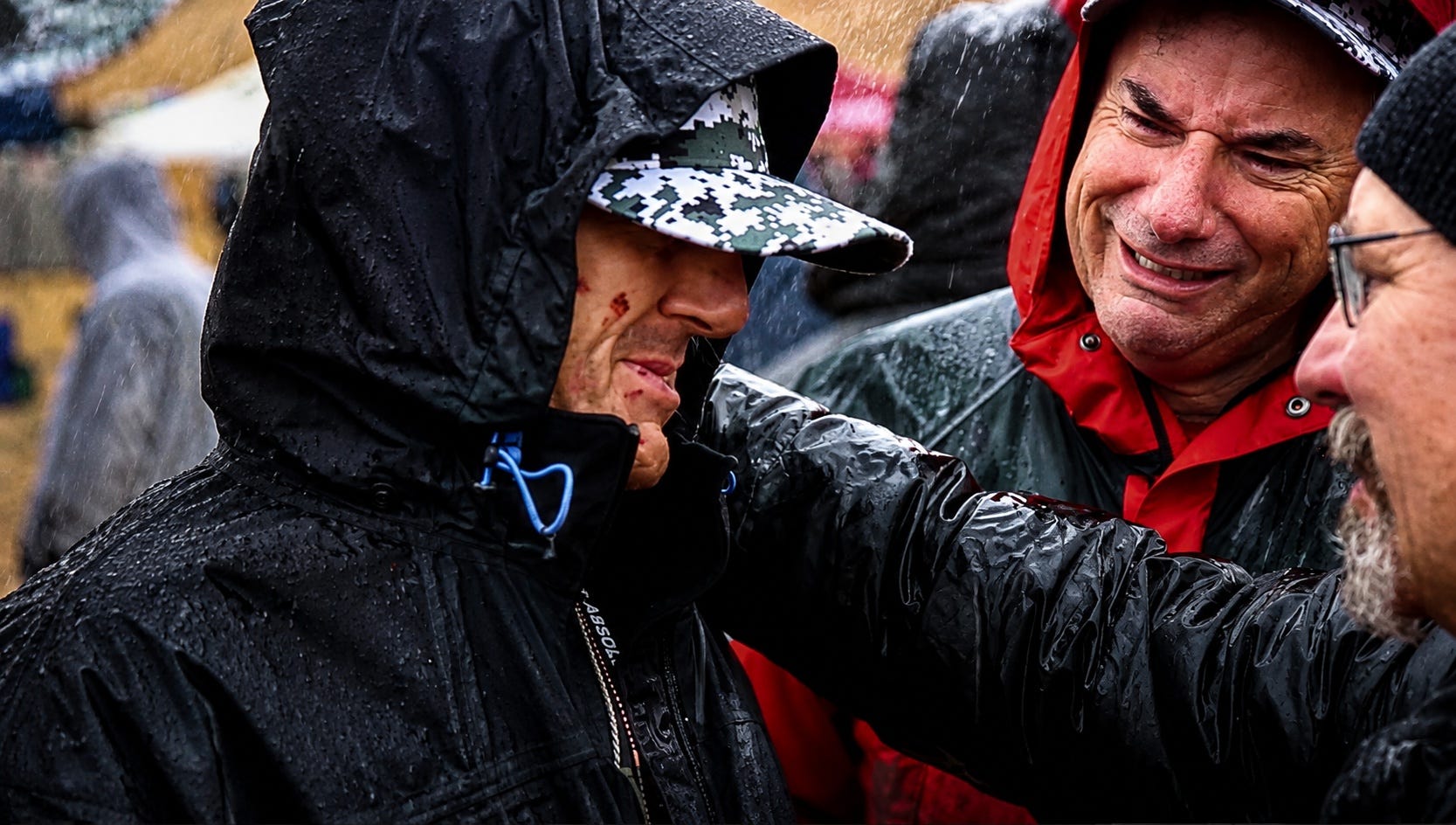
This photograph was taken at an M24 campout in 2013. David and I were praying with a homeless man as he surrendered his life to Jesus and accepted Him as Savior. I have never forgotten what it looked like to watch a man lay down what he had been carrying and receive a new life in Christ. Looking back, I realize that what began with one friend picking up a brick in my childhood eventually became two brothers helping another man lay down an entirely different kind of load.
When I asked him if he wanted to accept Jesus into his heart, he said yes.
Then he wept. David wept. I wept.
I will never forget the moment I looked into that man’s eyes. I saw the dark brokenness I had once experienced in my own life — and I know how deep it can go.
After we had spent time with him, I could see some of the weight coming off of him. I saw him reach for joy.
I don’t know where he is today. But I pray that what happened on that mountaintop helped change the direction of his life.
What started in a driveway ends up in places like this.
THE DRIFT
Trust yourself. Nobody else.
Carry your own weight.
Don’t owe anybody anything.
Help always costs something.
If you were stronger, you wouldn’t need it.
I listened to that voice for most of my life. It sounded like strength.
But looking back across all those years and all those wheelbarrows, I noticed something.
That voice never lifted a single brick.
THE REFLECTION
Looking back, I can finally see what my father’s driveway couldn’t show me at the time.
Discipline taught endurance. Friendship taught me I did not have to endure alone. Both prepared me for faith.
Every trial. Every business. Every friendship. Every loss. Every wheelbarrow. All of it was preparation — to fully trust Jesus.
But my father was not the one who set the first brick down.
I spent long stretches of my summers at my grandfather’s cabin. Three months at a time, some years.
He was a cruel man. What went on in that place should never happen to a child.
My grandfather was a pedophile.
I was one of the children in that house.
I was too young to have language for any of it. What I came away with wasn’t language. It was a conclusion I never chose: the people you are supposed to be able to trust are not always safe.
He died when I was about ten.
At the burial, I spit in his grave.
My grandmother slapped me. My father grabbed me and gave me a whipping. Other adults had plenty to say about what I had done. Afterward, at the gathering, they put me in a room by myself.
Decades have gone by, and one thing about that day has never faded.
No one ever asked me why I spit in his grave.
Had I told them, they probably all would have spit in his grave too.
And today I look back and wonder what bricks my dad had on him.
That driveway was still a couple of years away.
The first brick was distrust.
Everything else followed.
I learned to distrust help. So I carried everything myself. Sooner or later, a man who lives that way meets a load he cannot lift.
Not everything that happened to me was good. But God refused to waste any of it.
God was never after my performance.
He wants the whole heart — not ninety-nine percent of it.
It took five hundred bricks, a lifetime of wheelbarrows, and a disease I couldn’t fight before I finally gave Him mine.
One of the hardest things I had to learn was that receiving can also be a form of giving. Sometimes letting someone pick up the other handle gives them the same joy I have always found in helping someone else.
There is a kind of friend who can look at you and know what the need is without you ever voicing it. The kind who picks up the phone to tell you they’re sorry your dog died, and stays there and grieves it with you.
Even if they don’t own a dog.
It reminds me of the friendship I have with Jesus. And I believe He appoints special people in our lives to give us some of that friendship here on earth as well.
There are people who will know exactly who they are when they read this.
I’ve also learned that not every friendship goes this deep, and that’s okay.
Some people are in your life for a season.
A few stay for a lifetime.
At my age, those are the ones you can almost count on one hand.
When it is time for me to take my last breath, I know who I want standing at my bedside.
Jesus. My wife. My sister. And anyone who has gone this deep with me.
There were years when I wasn’t sure how far down the road I would make it.
If I could stand beside that seventh-grade boy today, I wouldn’t tell him to be stronger. He was already stronger than he knew.
I would tell him:
You did not fail.
You were trying to do the right thing with an instruction that was never fully explained.
Your heart was right, even if the bricks ended up in the wrong place.
Hang on, buddy.
You’re going to get farther down the road than you think.
A friend is about to walk into this driveway.
You don’t know it yet, but God is about to show you something you will carry for the rest of your life.
And one day you will learn who is worthy of your trust.
You don’t know Him yet the way you will someday — but He has been here all along.
The lesson was never in the punishment.
It was in the friend He was about to send.
WALKAWAY LINE
Sometimes Jesus doesn’t remove the whole load — sometimes He sends someone to help you lift the first brick.
SOMETHING TO THINK ABOUT
Who picked up a wheelbarrow for you?
Who needs you to pick one up for them?
And are you willing to let Jesus take the other handle?
MY PRAYER
Heavenly Father,
You saw a boy in a driveway with a load too heavy for him — and You were already building something he couldn’t see. Thank You for the friends You sent. The ones who helped because they wanted to. The ones who stayed. The ones who got on planes, held handles, and waited for me when they didn’t have to.
You know where the distrust started. You knew it long before I had words for it. Thank You for not leaving me there.
I confess how long I refused help because I believed it always came with a hook. Yours never did.
And Lord, keep my heart soft toward the ones who didn’t show up. I’ve been that person too. Let me release them without bitterness, and just be grateful for the hands You did send.
And for whoever is reading this — they have a driveway of their own. Bricks they’ve moved twice. Loads they’ve been carrying alone. Open their eyes to the friends You’ve already placed beside them. And show them the wheelbarrow You’re asking them to pick up for someone else.
Teach me to receive the way You give — freely, without leverage, without keeping score. I spent a lifetime learning who was safe. You were the answer the whole time. I don’t want to hold anything back anymore. Take Your handle, Lord. I’ll take mine. And wherever this load is meant to go, let’s carry it there together.
In Jesus’ name, Amen.
ABOUT G~
G~ writes from lived experience — exploring identity, authority, and time through the lens of faith, trial, leadership, and surrender. His reflections are not meant to condemn or hype, but to steady. Rooted in covenant, forged through adversity, and anchored under the authority of Jesus Christ, his work invites readers to examine who governs their lives — and to live intentionally under truth.
If what you’ve read resonates with your journey, feel free to reach out.
G~