

THE COYOTE BUSH
What grows where God sends the water
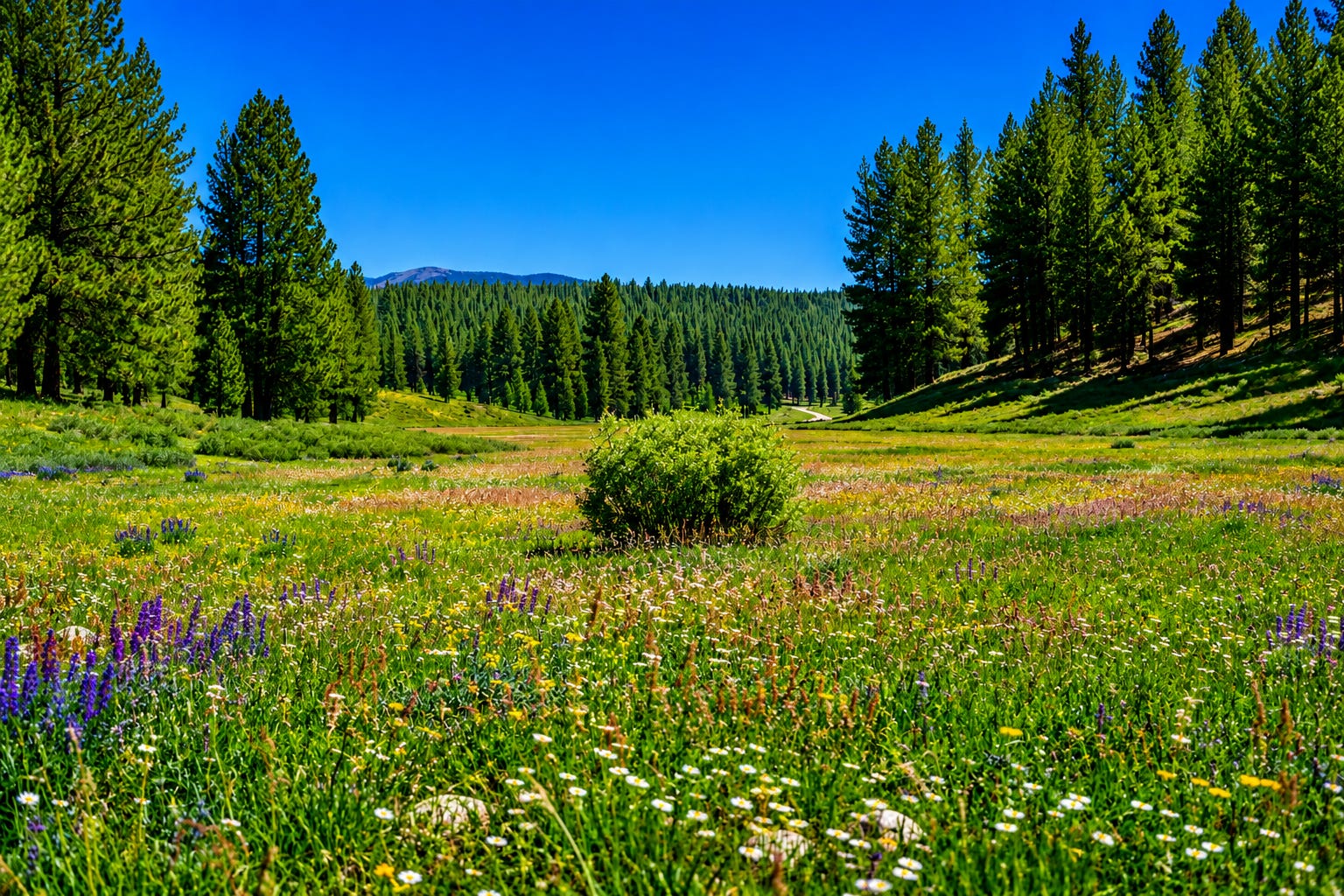
Truckee, California. June 13, 2026. I was walking the valley at my sister’s place with Marty, my sister, and eight dogs running ahead. It was peak daylight — the worst hour to photograph an open field, the kind of light that flattens everything. One bush stood alone in the center of all that space, and somehow the whole scene came together anyway.
Every creature in the valley seemed drawn to it.
The coyotes. The dogs. All of them.
I thought that was the story.
DEDICATION
To the Holy Spirit, who can take a bush in a valley and turn it into a mirror.
To Marty, who walked beside me while God let the field speak.
To my sister, whose valley gave me the picture and whose words opened the thought.
To the reader, tired of marking what God never asked them to own — and ready to be rooted where He is watering.
SCRIPTURE
“He shall be like a tree planted by the rivers of water, that brings forth its fruit in its season, whose leaf also shall not wither; and whatever he does shall prosper.” — Psalm 1:3 (NKJV)
“Yea, though I walk through the valley of the shadow of death, I will fear no evil; For You are with me; Your rod and Your staff, they comfort me.” — Psalm 23:4 (NKJV)
“But those who wait on the LORD shall renew their strength; they shall mount up with wings like eagles, they shall run and not be weary, they shall walk and not faint.” — Isaiah 40:31 (NKJV)
“Abide in Me, and I in you…” — John 15:4 (NKJV)
THE HOOK
I saw it before I understood it.
A single bush, standing alone in the center of a vast Truckee valley.
Not tucked under the trees.
Not hidden in the shade.
Not leaning against the hillside for cover.
It stood in the open, under the full weight of the sun, surrounded by miles of field and wildflowers and sky and silence.
And somehow, it looked like it owned the ground it had grown from.
THE STORY
On June 13, 2026, I was walking the valley at my sister’s place in Truckee with Marty, my sister, and eight dogs moving ahead of us like they’d been handed temporary ownership of the land.
I was moving slow. The rocks, the uneven ground, my own unstable footing — all of it kept me deliberate. A ski pole in one hand for balance, my camera in the other. Marty and my sister kept an eye on me as I picked my way through.
I was hunting the shot.
It was noon. The valley was hot. The sun sat straight overhead — the worst time of day to take a photograph. High sun. Harsh light. Open field. The kind of light photographers learn to avoid, because it flattens everything and makes beauty harder to catch.
So I kept looking anyway, hoping. Because God doesn’t always wait for perfect light to show you something worth seeing.
And then — there it was.
In the center of that valley stood one large bush. Not near the tall trees. Not tucked into the shaded edge. Not protected by the hillside. Out in the middle of everything, alone, with a kind of quiet authority.
I stopped and said, “Wow. That is quite a bush.”
And it was.
It looked like a statement of survival.
Here I am.
Among the tall trees.
Out in the open.
Still growing.
It wasn’t proud. It wasn’t loud. It wasn’t trying to draw attention to itself. It simply stood there, full and alive, as if it had learned something about that valley everything else had missed.
Then my sister said something that made me laugh.
The coyotes come down from the hills and mark that bush all the time, she said.
And right about then, our dogs reached it and started doing the very same thing. One by one, they went over and left their message.
I laughed, because the whole thing was so earthy and ridiculous and perfect.
That bush had become the bulletin board of the valley. The central post office. The gathering place. The one spot where every passing creature seemed to stop and say, “I was here.”
So I gave it a name.
The Coyote Bush.
Later, my sister told me that bush had been standing there since she moved in back in 1999 — and probably long before that.
Since 1999, she had watched it hold that same spot — twenty-seven years of seasons. A little larger every year. Still there every season.
Coyotes came to it. Deer came near it. Just about every four-legged creature in that forest seemed to find its way to it. And because my sister runs a dog camp — sometimes as many as seventeen dogs on the place — the pattern repeated every time they took the trail through that valley.
The dogs knew it. The wild animals knew it. The valley knew it.
That bush was not a moment.
It was a witness.
THE MOMENT
But the longer I looked at it, the more something turned over in me.
That bush wasn’t standing there because the coyotes marked it. It wasn’t full and alive because the dogs stopped by. Its authority in that valley had nothing to do with the traffic around it.
I had the whole thing backwards.
The bush was not growing because everything marked it.
Everything marked it because it was growing.
THE TURN
Its life was coming from somewhere the marking never touched.
From underneath. From above.
The winter runoff. The seam of water that ran through the low place. The minerals gathered where the ground dipped. And over all of it, the open sky and the direct, unbroken light.
Water below. Light above.
That bush had found the one place in the valley where hidden water and open light met. That’s why it thrived.
There was something else about it, too.
It was round. Almost perfectly balanced.
It hadn’t stretched off in one direction, straining for a single break of light. It wasn’t lopsided from living on one thin trickle of water. It looked like it had been fed from every side and touched by light from every angle.
That became another mirror.
A faith fed from only one side can grow misshapen. But a life receiving from God in every direction — His Word, His Spirit, prayer, suffering, surrender — begins to take a different shape. Not perfect. But formed.
And as I looked around, I noticed the others. Smaller bushes, closer to the trees. Tucked into the shade. More cover. More protection.
And smaller. Many of them don’t make it through the winter. They have shelter, but not enough light. They have cover, but not the same water.
The exposed bush had both. The protected ones were slowly losing the fight. What looked the most vulnerable, out in the open, was the most sustained thing in that valley.
The bushes along the shade lines were seasonal. They’d come up green, but after the winter snow, many of them shrank back or sank into the soil — alive for a stretch, then gone. They never reached the runoff or the open light the way that lone bush had.
And faith can be like that.
Sometimes our hearts get planted in shaded places and unwatered soil. We look alive for a season. Then the branches start to dry. We shrink back. We survive in appearance, but we never grow the deep, thriving connection to the Father that carries a life through winter.
That is why location matters. Not just where our feet stand. Where our hearts are rooted.
Sometimes we ask God for shade when He is trying to grow us in the open.
Then the question came. Not loud. Not complicated. But deep enough to stop me where I stood.
Am I rooted where God is watering — or am I just marking what someone else’s roots have produced?
THE DRIFT
Because people do this too.
We circle the same bushes. Social media. Old arguments. Family roles. Reputation. Control. Past success. The old wound we keep coming back to scratch. The familiar ache of “they should have seen me.” The worn-down place that says, “I need to prove I mattered.”
And the flesh has such reasonable words for it.
We call it legacy.
We call it discernment.
We call it ministry.
Sometimes it’s legacy, and sometimes it’s only insecurity. Sometimes it’s discernment, and sometimes it’s only control. Sometimes it’s ministry, and sometimes it’s only the need to be noticed. Sometimes we aren’t bearing fruit at all. We’re just leaving a scent on the bush to prove we passed through.
But not every mark begins in pride.
Sometimes a mark is a message. A way of saying, “I’ve been here before.”
I spent years backpacking in Yosemite, marking a trail so I’d know if I’d looped back, wandered off, or come round to the same place again.
A mark can help you remember where you’ve been. But it can fool you if you start trusting the mark more than the Guide — and sooner or later someone comes along and moves it, rewrites it, changes the sign you were leaning on.
That’s why I can’t build my life around the marks.
I need the Shepherd.
I know that pattern from the inside. Not from watching other men fall into it — from living there myself, longer than I’d ever want to admit.
For most of my life I moved from bush to bush with an entrepreneur’s spirit. I built things. I mastered things. I solved the problem, ran the business, left my mark on the season — and once I’d conquered one thing, I went looking for the next. Another hill. Another challenge. Another place to prove I could make something grow.
Then one day, without choosing it, I found myself in a valley. Physically. Spiritually. Emotionally.
Health trials came. Pain came. Limits came. Stillness came. Age came. Loss came. The pace changed, the tools changed, the body changed.
There are valleys you hike into by choice, and valleys you find yourself in because life walked you there.
And at first all I did was look for the way out. I didn’t want the valley. I wanted the next hill.
So I stood in the low place, looking around for a bush to climb toward.
And slowly, God showed me something I didn’t want to see at first.
I was the bush.
He hadn’t set me down in that valley to bury me. He’d planted me there to water me. The suffering, the prayer, the stillness, the illness, the marriage, the Scripture, the surrender — that was the hidden seam of water, running right under the place I thought was my ending.
I thought I’d been set aside. He was rooting me.
I thought I’d been hidden. He was watering me.
I thought I’d lost the open field. He was giving me the light.
THE REFLECTION
And over time, people came.
Some came for shade. Some came to leave a mark. Some came with encouragement, some with wounds, some with judgment, some with love. Some came just to know they weren’t the only one standing in a valley they never chose.
But not one of them was the source.
That’s the difference between being marked by the world and being rooted by God. One leaves a scent. The other gives life. The world can notice what God has grown, gather around it, even leave its mark on it — but it can never become the water.
I thought about the old parable of the eagles set down in a valley where food was everywhere and nothing was hard. No hunting. No wind. No long climbs. At first it looked like a blessing — everything they needed, right there on the ground.
But the eagles stopped flying. They stopped facing the wind, stopped using their wings, grew content feeding from the valley floor. And when the storm finally came, when the season turned, they couldn’t rise. They still had wings. They’d just lost the strength to use them.
The same valley held two different lessons.
The bush thrived because it was rooted where God gave water and light. The eagles failed because they settled for comfort and forgot the wind.
A valley can nourish what God plants. It can also weaken what refuses to rise. The danger isn’t the low place — it’s mistaking provision for permission to stop growing.
And maybe that’s what still has me thinking.
How many times do we walk past a bush and never think twice? How many times does something stand right in front of us — full of years, full of quiet survival — and we look straight past it because our eyes are fixed somewhere else?
I’m still trying to understand why that bush caught me the way it did. Maybe it wasn’t only the bush. Maybe it was the invitation to stop. To turn aside. To notice.
Moses saw a bush burning in the wilderness, but the holy moment didn’t begin until he turned aside to look. He stopped long enough for God to speak.
This wasn’t that bush. It wasn’t burning. It wasn’t Sinai. It was a Truckee valley — full sun, eight dogs, uneven ground, and one old bush standing where water and light had kept it alive.
But God still used it to stop me.
And sometimes that’s the mercy. Not every holy interruption comes wrapped in fire. Sometimes it looks like a bush in a valley, standing quietly for twenty-seven years, waiting for the day you finally have eyes to see it.
Sometimes Jesus is closer than the thing we’re staring at. Sometimes He’s standing right in front of us, knocking at the patio door, while we’re busy looking past Him into the yard.
We keep scanning the distance for a sign and miss the One already here. We keep waiting for God to speak from somewhere dramatic while He’s using something ordinary to interrupt us.
A bush. A valley. A trail. A camera. Eight dogs. A slow walk. A thought that won’t let go.
Maybe faith begins again the moment we stop looking past what God set right in front of us.
And I’m grateful.
I think I can speak for Marty and my sister when I say it.
We’re still able to walk that valley.
Still able to notice the bush.
Still able to laugh at the dogs.
Still able to leave a message.
And maybe that’s different from trying to mark what God never asked us to own.
There is a difference between leaving a mark to prove you mattered and leaving a message of gratitude because God let you pass through one more time.
One says, “Remember me.”
The other says, “Thank You, Lord — I’m still here.”
Near the Coyote Bush were two smaller ones. A fraction of its size, but there. Growing. Reaching for the same seam of water, the same sun.
And after thinking about a bush that had held its place for twenty-seven years, I thought about how this ends. One day the old bush fades. Its season closes. But before it does, it drops seed.
That’s the legacy worth leaving. Not a mark. Life.
A mark says, “I was here.”
A seed says, “Something can grow after me.”
I’ve left enough marks. I’d rather leave seed.
Maybe that’s what God’s been teaching me in this season. Stop spending your strength marking someone else’s bush. Cultivate the one He planted you to become. Let Him root you where the water gathers. Let His light reach the places you keep trying to hide in the shade. Let the valley do its quiet work. And when the time comes — drop seed.
The flesh wants to leave a mark. The Spirit teaches us to grow roots.
The flesh wants territory. The Spirit bears fruit.
The flesh wants to announce itself.
The Spirit abides.
WALKAWAY LINE
The world may mark what God has watered, but it cannot become the source.
SOMETHING TO THINK ABOUT
What has God placed in front of you that you keep looking past?
Are you rooted where God is watering — or are you circling what someone else’s roots have produced?
Are you leaving a mark just to prove you were here — or are you dropping seed so something can grow after you?
MY PRAYER
Heavenly Father,
Teach me the difference between leaving a mark and bearing fruit.
Root me where You are watering. Let Your light reach the places I keep trying to hide in the shade.
Deliver me from the need to own what You only asked me to observe. Deliver me from the need to prove I was here.
Teach me to stop long enough to see what You have placed right in front of me.
If I am in a valley, show me whether You are rooting me, renewing me, or calling me to rise. Give me the humility of the bush that receives water in the low place, and the patience to wait on You until You say rise.
Let my roots find Your water.
Let my life receive Your light.
Let my season leave seed.
In Jesus’ name,
Amen.
ABOUT G~
G~ writes from lived experience — exploring identity, authority, and time through the lens of faith, trial, leadership, and surrender. His reflections are not meant to condemn or hype, but to steady. Rooted in covenant, forged through adversity, and anchored under the authority of Jesus Christ, his work invites readers to examine who governs their lives — and to live intentionally under truth.
If what you’ve read resonates with your journey, feel free to reach out.
G~
Oh my goodness Bro!! That was so good and just loaded with gold.
“It wasn’t proud. It wasn’t loud. It wasn’t trying to draw attention to itself. It simply stood there, full and alive, as if it had learned something about that valley everything else had missed.”
This caught me, the more I read, I began to ask, am I the bush?
Thank you, this was refreshing and encouraging!! Love you my Friend