

THE CLIMB
Some strength is built where no one is watching.
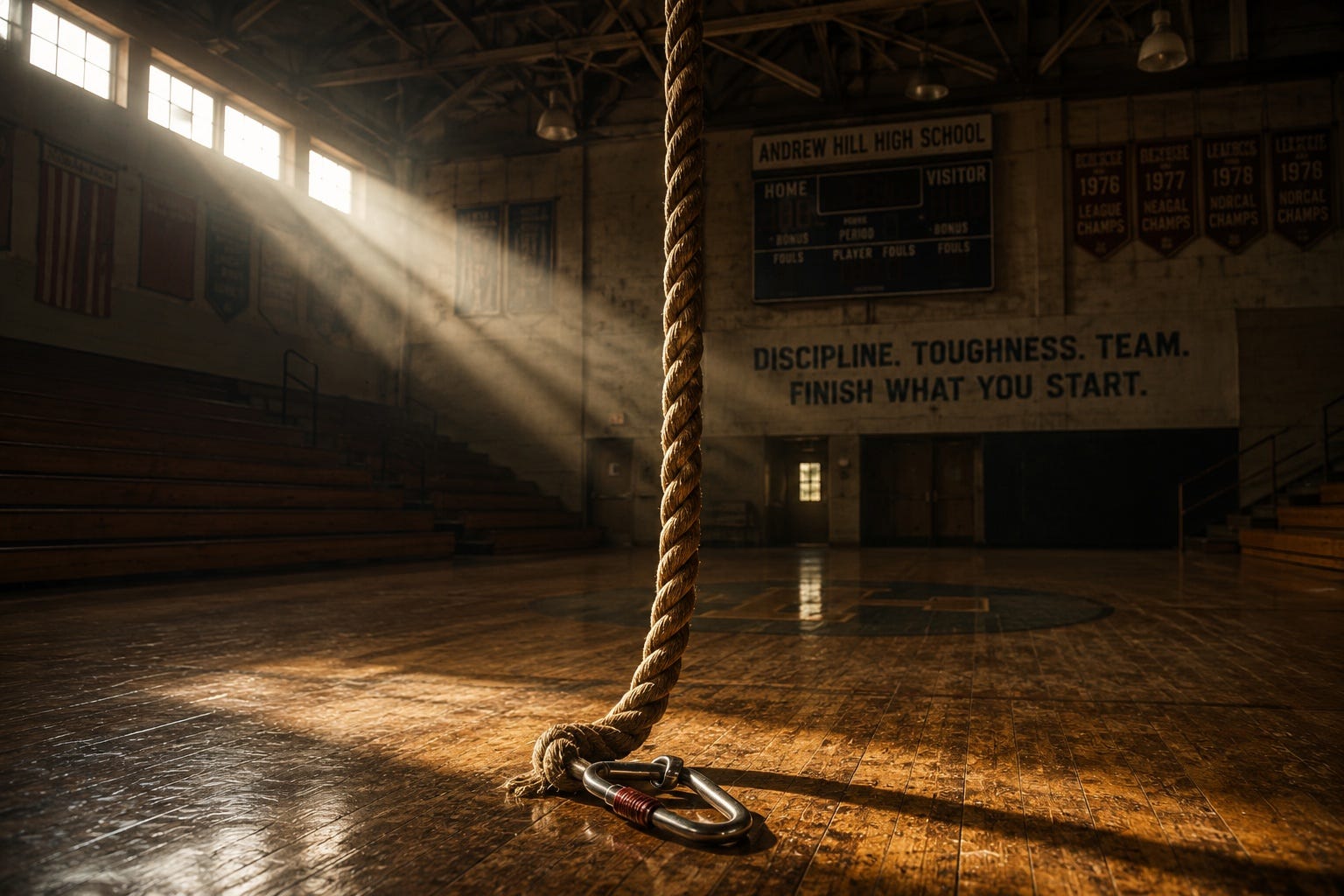
This is not the gym at Andrew Hill. But the light is right. The dust is right. The empty bleachers are right. And the rope is exactly right. I spent a season of my life beneath one just like it — looking up, reaching higher, and returning when no one else was in the room.
They gave me a name I never chose.
A rope I couldn’t climb.
And an empty gym that changed everything.
DEDICATION
To the Holy Spirit — who was with me before I recognized His presence, and who held me long before I knew how to hold on.
To the coaches in my life — few, but powerful.
To Mike Stanley — coach, brother, fellow climber. Still on the rope.
To Marty, my wife — always supporting my writing, always encouraging me, always holding me with her love.
To the reader whose grip is weak, loosening, or unsure — still discovering what is worth holding onto. May you be strengthened, and encouraged to keep growing that strength.
SCRIPTURE
“For who has despised the day of small things?” — Zechariah 4:10 (NKJV)
“…let us run with endurance the race that is set before us…” — Hebrews 12:1 (NKJV)
“This hope we have as an anchor of the soul, both sure and steadfast…” — Hebrews 6:19 (NKJV)
THE HOOK
1974. Andrew Hill High School. Freshman year.
Coach Shalaba’s PE class was not built for freshmen. Only two of us in that class were freshmen. The rest of the room was filled with older JV and varsity athletes — bigger, faster, already performing at another level. Jim McMahon was one of them. That tells you something about the caliber of the room.
And then there was me.
I was overweight. The room could see that before it knew anything else about me.
Coach Shalaba was the first to say it. He called me “Marshmallow” instead of Marchand, and the room took it from there.
A name like that isn’t a description. It’s a verdict. Soft. Easy. Done before it starts.
What came next hurt even more.
He refused to leave me alone.
Extra drills when the drills were over. Extra conditioning when the conditioning was done. Constant pressure, every class, aimed straight at the freshman least equipped to handle it. I couldn’t tell whether he was trying to break me or build me.
At that age, the two feel identical.
THE STORY
There was a rope in that gym. It hung from the rafters to the floor, and every time I walked past it, it asked me a question I didn’t want to answer.
So I decided to answer it where nobody could watch.
After school, when the gym emptied and the doors stopped swinging, I stayed. Nobody knew. Not Coach Shalaba. Not the athletes. Nobody. Just me, a rope, and the particular silence of an empty gym — the kind of quiet where you can hear your own hands failing.
Progress came in inches. Real inches. Some afternoons I gained a hand’s width. Some afternoons I gave it back. My arms shook. My grip burned. The rope didn’t care. Ropes never do.
There is no applause in an empty gym. Nobody claps for inches.
But one afternoon — no crowd, no coach, no witness — my hand touched the ceiling.
I hung there for a moment at the top of the room that had named me Marshmallow.
Then I came down, picked up my books, and told no one.
THE MOMENT
Coach Shalaba ran a drill with a length of hose. Two men. One hose. You kept your grip, or you didn’t.
The day my name got called, another name got called with it.
Overstreet.
Senior. Varsity linebacker. One of the biggest athletes in school. The room didn’t laugh out loud, but it didn’t have to. Everybody already knew how this ended.
We took our grips. And somewhere in the first pull, something in me made a decision my body would have to keep:
I was not letting go.
He was stronger. He was heavier. Most of the time, my feet were not even on the mat. He had every advantage but one — he assumed there was a point where I would quit. I had spent a season alone in that gym discovering there wasn’t.
I don’t know how long it lasted. I only know how it ended.
With the hose in my hands.
No cheering. No noise at all. Just silence — the sound a room makes when it has to rewrite what it thought it knew.
Coach Shalaba gave it two words.
“Good match.”
Then came the day the ropes were part of class. In front of everyone.
When my turn came, I climbed to the ceiling and came back down.
Then I climbed it again. And came down.
Then I climbed it a third time.
And the room erupted. The same athletes. The same gym. The same kid they had named Marshmallow — and this time Coach Shalaba saw it, all of it, everything those empty afternoons had built into me.
I never let him see me practice.
He only got to see what the practice had made.
The match was won in public.
The strength was built in secret.
THE TURN
I never became a star athlete. That was never where this story was going.
But the nickname died somewhere between the hose and the third climb, and it never came back. I left that gym strong. Competitive. Respected.
And I left with a lesson I would carry for fifty years — and get half wrong for most of them.
Here is the half I got right:
I did not become strong and then climb.
I climbed.
The climb made me strong.
The strength never comes first. The showing up comes first — the empty gym, the shaking arms, the inches. God builds strength the same way, in rooms nobody applauds, long before there is ever a moment worth watching.
Here is the half I got wrong:
For most of my life, I thought the lesson was grip.
THE DRIFT
Hold on tighter.
Grip harder. Outlast everyone.
If your hands are strong enough, you’ll never fall.
It all depends on you.
I believed every word of that. I had the calluses to prove it. Then life began hanging weight on my rope that no human grip could carry — illness, loss, betrayal, pain, and seasons that emptied without warning — and I learned something that gym never taught me.
My hands were never the problem.
The problem was what my rope was tied to.
THE REFLECTION
Look at the photo again. Not the rope this time — the bottom of it.
There is a carabiner lying there. Old. Scarred. Built for one purpose: connection. A climber’s whole life travels through that small gate of steel, because a climber’s rope is only as good as its anchor. You can have iron hands on a rope tied to nothing, and all you have done is decide where you will fall from.
Every life is tied to something. Approval. Performance. Money. Recognition. Health. Relationships. Fear. Control. We clip in early — usually without ever deciding to — and we climb for decades trusting that the anchor will hold.
Then the full weight comes down. And every one of those anchors, sooner or later, fails. Not because we didn’t grip hard enough.
Because they were never load-bearing.
I have been at the end of my rope more than once. I used to think that was the tragedy of the story. I don’t anymore. Sometimes reaching the end of our rope is where the greatest revelation begins — because the end of the rope is where you finally stop staring at your grip and look up to see what it’s tied to.
For most of my life I asked the wrong question about that gym.
The question is not, “How strong is my grip?”
The question is, “What is my rope anchored to?”
Hebrews calls hope an anchor of the soul. Every other anchor I ever trusted eventually gave. Christ has held every ounce of weight I have ever put on Him.
And climbers know one more thing about carabiners. Sometimes you clip into another climber. Sometimes another climber clips into you.
Which brings me to Mike Stanley.
Mike is a coach. Not was — is. The field changed; the calling never did. Years ago he walked The Journey, a discipleship road I had the honor of leading him down. And when he reached the top of it, he didn’t unclip. He turned around and brought other men up behind him. His body is aging now. His faithfulness is not.
He wrote me something recently that I have not been able to put down:
“You write so beautifully and with such truth. As always you inspire me. Greg let’s finish well together.”
Read that last line again. A man who spent his life coaching is not asking me to help him win.
He is asking me to help him finish.
A younger coach demonstrates strength with his body.
An older coach demonstrates faithfulness with his life.
Coach Shalaba taught me not to let go of the hose. Mike Stanley is teaching me not to let go of the rope. And both of them, in different decades, have been pointing at the same truth:
We are not done on the rope until God says we are done.
We may clip into one another — brothers, coaches, climbing partners for a stretch of the wall. But every rope must ultimately be anchored to Christ. Because someday every hand weakens, every coach ages, every climber comes to the end of his rope.
And on that day, your grip will not be the question.
Your Anchor will.
As for me, I settled that question a long time ago.
No longer a marshmallow. A rock for Jesus now — not because my grip never weakens, but because my Anchor never does.
WALKAWAY LINE
The question was never how strong my grip was — it was what my rope was anchored to.
SOMETHING TO THINK ABOUT
What is your life anchored to — and will it hold when your full weight comes down on it?
Who is connected to your rope, watching how you climb?
MY PRAYER
Heavenly Father,
Thank You for the empty gym. Thank You for every season You built strength into me when I believed no one was watching — and for the truth that You were there for every inch of it. Thank You for the coaches who pushed me, for the brothers who clipped into my rope, and for the ones who let me clip into theirs.
Forgive me for the years I trusted my grip — for every anchor I chose that was never meant to hold me. Anchor my life in Jesus Christ, the One who has never failed.
And Father, for Mike, and for every brother still climbing — keep us faithful to the end. Don’t let us come off the rope until You say we are done.
In Jesus’ name, Amen.
ABOUT G~
G~ writes from lived experience — exploring identity, authority, and time through the lens of faith, trial, leadership, and surrender. His reflections are not meant to condemn or hype, but to steady. Rooted in covenant, forged through adversity, and anchored under the authority of Jesus Christ, his work invites readers to examine who governs their lives — and to live intentionally under truth.
If what you’ve read resonates with your journey, feel free to reach out.
G~